
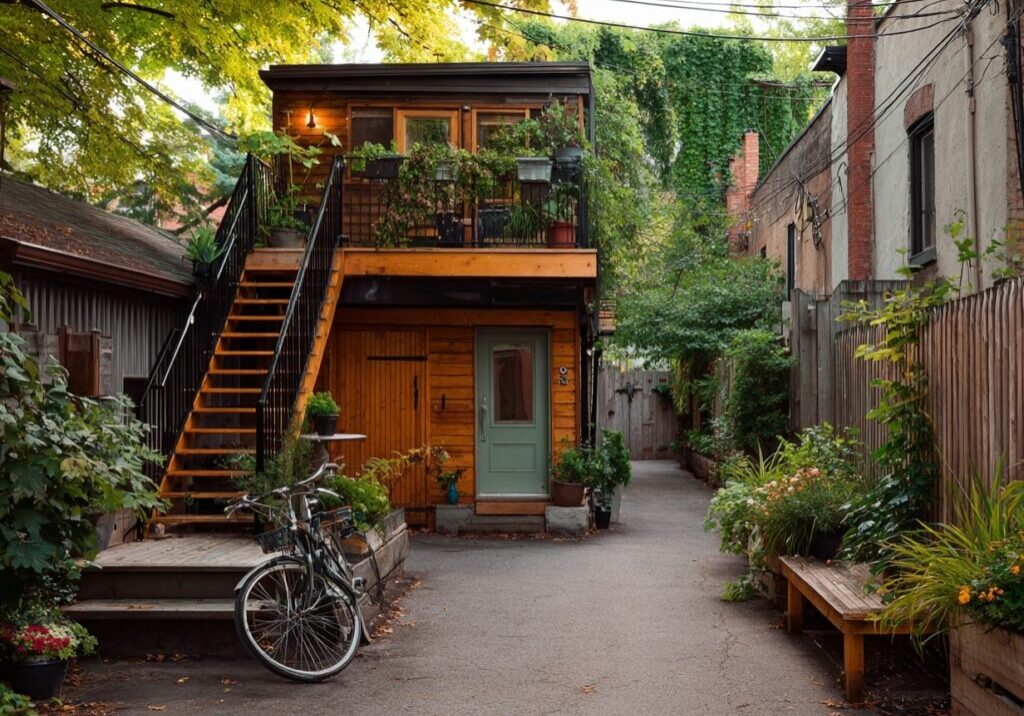
If your Toronto lot is in a low‑rise residential zone, you can usually add one detached secondary dwelling at the rear: a garden suite if you do not abut a public laneway, or a laneway suite if you do. The big picture is simple: check your lane access, separation to the main house, setbacks, height, and fire access. Those five items decide feasibility nine times out of ten.
Thinking about a full ground‑up build instead? As a custom home builders in Toronto, we can guide you through every step of the way of your multifamily or laneway home build.
Garden Suite Vs Laneway Suite: What’s The Difference?
A garden suite is a self‑contained home in an ancillary building, typically in the backyard and not on a public lane. It is separate from the main house and shares the lot’s services. A laneway suite is similar but sits next to a public laneway and must share a lot line with it. Both are intended as low-rise, rental‑friendly housing types.
The distinction matters because lane adjacency changes setbacks, access, and height rules. In short, garden suites follow rear‑yard rules, while laneway suites also have lane‑facing conditions and fire access options through the lane. If you’re unsure which you qualify for, confirm whether your rear or side lot line actually touches a public laneway.
Quick Self‑Check: Is A Secondary Suite Realistic On My Lot?
The 10‑Minute Scan
Start with the lane test. If your lot abuts a public laneway, you may explore a laneway suite. If it does not, focus on a garden suite. This one fact narrows your path.
Next, sketch the separation to your main house. Plan for 4.0 m if the suite is no taller than 4.0 m and 7.5 m if it is taller. Laneway suites now use this rule city‑wide under By‑law 847‑2025; garden suites have been aligned by Council under 849‑2025.
Measure setbacks. For garden suites, a typical rear setback is 1.5 m and side setbacks are the greater of 0.6 m or 10% of lot frontage (more if there are openings). For laneway suites, many side conditions allow 0.0 m where there are no openings, and 1.5 m at a lane‑facing rear.
Finally, confirm fire access. You need a clear path to the suite entrance with minimum width and height, plus travel distance limits from the street or lane. This is often the make‑or‑break item.
When You Might Need A Minor Variance
Some lots can meet every rule except one. Common variance triggers include mature tree protection zones, unusual lot widths, heritage overlays, or tight separations that limit height. A small, well‑justified variance can still be approved if the design respects neighbourhood character and technical requirements.
Design strategy matters. We often adjust roof forms, window placements, or the building footprint to avoid avoidable variances. If you do need the Committee of Adjustment, go in with a crisp rationale and clean drawings that show compliance everywhere else.
The Rules That Matter (With A Simple Comparison)
| Topic | Garden Suite | Laneway Suite |
| Where It’s Allowed | Rear yard, not abutting a public lane. | Lot must share a lot line with a public laneway. |
| Separation From Main House | 4.0 m if height ≤ 4.0 m; 7.5 m if height > 4.0 m. (Aligned July 24, 2025 under By‑law 849‑2025; previously 5.0 m/7.5 m.) | 4.0 m if height ≤ 4.0 m; 7.5 m if height > 4.0 m (By‑law 847‑2025). |
| Maximum Height | Up to 4.0 m when close to the main house; up to 6.0–6.3 m when 7.5 m away, per the 2025 alignment. | Up to 4.0 m when closer than 7.5 m; 6.3 m if 7.5 m or more. |
| Rear Setback | Generally 1.5 m (deeper lots: half the height or 1.5 m). | Often 1.5 m to the lane when a parking space faces the lane; other conditions vary. |
| Side Setback | Greater of 0.6 m or 10% of frontage; more where there are openings. | Can be 0.0 m where there are no openings on interior lots; otherwise follow prescribed side setbacks. |
| Parking | No car parking required; provide 2 bicycle spaces. | No car parking required; bicycle parking required by the by‑law. |
| Footprint / Area | Max footprint is the smaller of 60 m² or 40% of rear yard; GFA caps updated in 2025 to 60 m² (1‑storey) or 120 m² (2‑storey). | |
| Pre‑Approved Plans | City offers pre‑approved plans to speed permitting; site conditions still apply. | Same as garden suites. |
Bottom line: The 2025 alignment removed several legacy constraints and harmonized separation and height rules. Always confirm your site against the current by‑law text during zoning review.
Fire Access And Trees: The Two Deal‑Breakers
Fire Access
Toronto Building and Toronto Fire require a clear access path from the street (or lane) to the suite entrance with specific width, height, and travel‑distance limits. Expect a 1.0 m x 2.1 m unobstructed path for non‑sprinklered garden suites, with a maximum 45 m travel distance from the public street. Laneway suites follow similar travel‑distance rules and can use the lane in some cases, up to 90 m with additional fire‑safety measures acceptable to the City.
Trees. By‑law‑protected trees often constrain placement and excavation. Early Urban Forestry input avoids redesigns or permit refusals. The City’s summary notes that healthy, protected trees should not be removed for garden suites and that tree permits may be refused if harm is likely. Design with root zones in mind from day one.
Permits, Plans, And A Clean Path To Approval
Your Permit Package
A tight permit set reduces back‑and‑forth. At minimum, plan on a current survey, a site plan with zoning summary, grading and drainage details, code‑compliant floor plans, elevations, building sections, and the required Ontario Building Code forms. Fire access diagrams and any tree protection plans should be included up front to prevent delays.
We handle BCIN permit‑ready drawings in‑house and coordinate directly with Toronto Building. Our design‑first approach aims to avoid unnecessary Committee of Adjustment applications by solving problems in the drawings, not in hearings.
Pre‑Approved Plans Can Save Time
Toronto’s pre‑approved plans can shorten review and give you a proven envelope that already satisfies many code and zoning elements. You still need a permit and site‑specific checks like setbacks, separation, fire access, and trees. Referencing the plan set and number in your application helps intake triage your file.
If your site conditions differ from the pre‑approved layout, we adapt the plan while keeping the compliant intent. That keeps your drawings close to a known standard and reduces risk at review.
Costs And Timeline You Can Actually Plan For
Your soft costs include the building permit fee and any review fees. For financing context, the City operates a Development Charges (DC) Deferral Program for laneway and garden suites, and in July 2025 Council added exemptions for developments with up to six units, subject to conditions and provincial legislation. Treat DCs as case‑specific and confirm eligibility early.
Schedule. Two factors drive time more than anything else: design clarity and reviews for fire access and trees. A clean first submission avoids weeks of resubmissions. If a minor variance is truly required, add Committee of Adjustment time to your plan.
Can I Sever My Lot If I Build A Garden Suite?
No. Garden suites are meant to function as secondary units on the same lot and are not intended to enable lot severances. The City’s guidance is explicit on this point.
Do I Need Car Parking For A Garden Or Laneway Suite?
No car parking is required for either. A garden suite must provide two bicycle parking spaces. Laneway suites also require bicycle parking under Section 150.8.
How Close Can The Suite Be To My Main House?
Plan on 4.0 m if the suite is 4.0 m tall or less, and 7.5 m if taller. Council aligned these standards across suites in July 2025.
How Tall Can I Build?
Laneway suites can be up to 6.3 m when at least 7.5 m from the main house. Garden suites have been aligned to similar height logic in the 2025 update. Always confirm your specific context in the current by‑law.
Are Basements Allowed In Garden Suites?
Yes, basements are permitted for garden suites, subject to Building Code and site conditions such as drainage and tree protection.
What Usually Blocks Approval?
Fire access that does not meet width or travel‑distance rules and conflicts with by‑law‑protected trees are top blockers. Tackle both in concept design before you finalize plans.
Do Pre‑Approved Plans Skip Review Entirely?
No. They streamline review but you still need a permit, and the City will check your site for setbacks, separation, fire access, and trees.
How We Help And Why It Matters
We design and permit secondary suites with a fixed‑price contract and a 2‑year warranty on materials and labour. You get a dedicated project manager and a client portal with 24/7 access, daily logs, and progress photos.
Our in‑house design team prepares and stamps BCIN permit‑ready drawings for your multifamily or laneway home build. We handle zoning checks, fire access coordination, tree protection strategies, and permit submissions. We also look for smart design moves that keep you away from the Committee of Adjustment when possible.
Contempo Building Corp is a proud member of BILD and RenoMark. You’ll feel the difference in process, documentation, and site execution. Ready to confirm what your lot allows and map the fastest permit path? Book a consultation and we’ll run the numbers.